

Structuring the First 12 Months of a Startup
How to turn chaos into clarity using simple, reusable templates

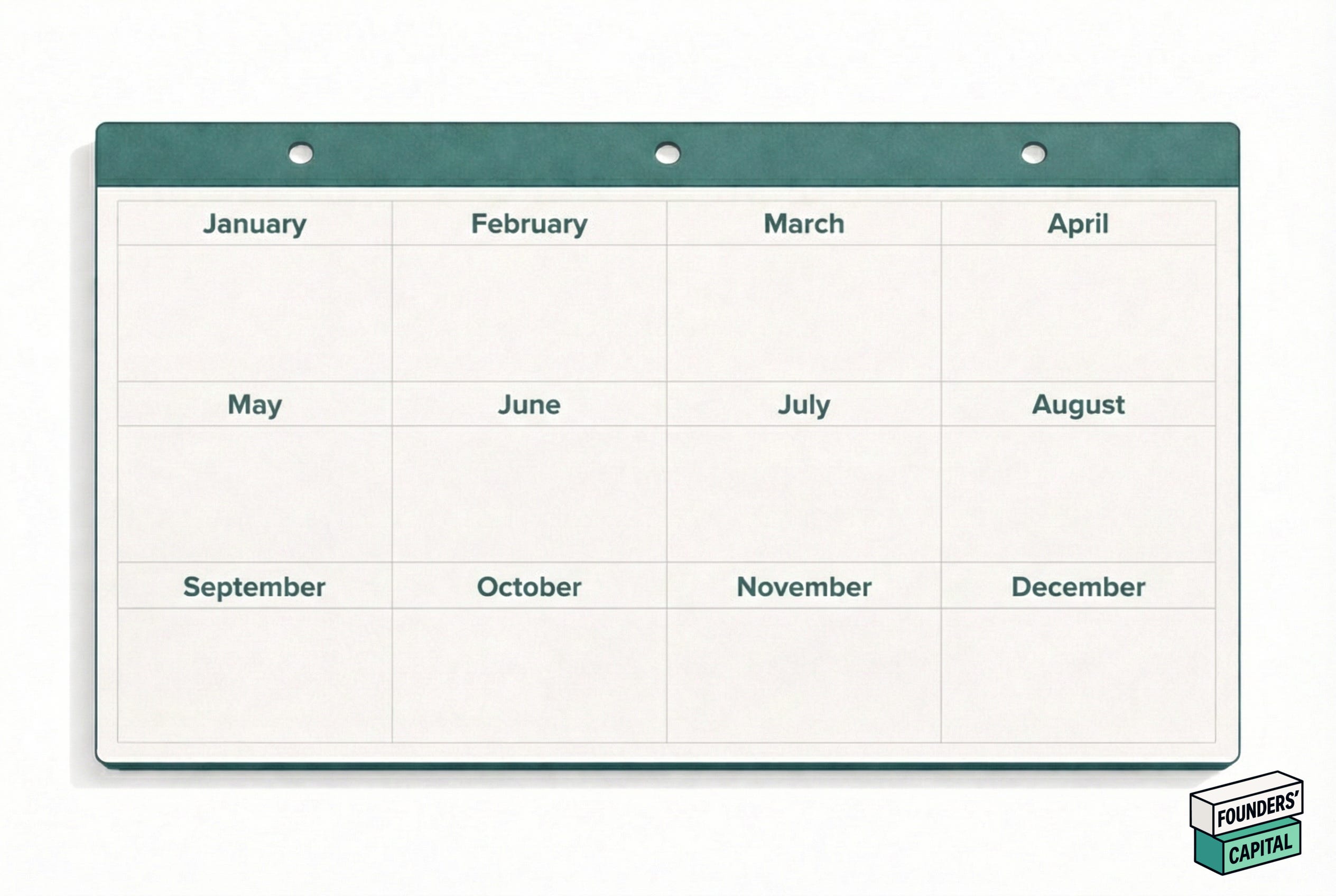
Why most first years feel chaotic
Most founders don’t fail because they didn’t work hard enough.
They fail because their first year had no structure.
The early months of a startup are usually a blur of ideas, urgency, and reacting to whatever feels most pressing. In hindsight, founders often say the same thing: “We were busy, but not intentional.”
This guide is not about predicting the future.
It’s about creating containers; its about simple structures that help you decide what to focus on, when, during your first 12 months.
Below is a practical way to break your first year into four phases, along with high-quality templates you can reuse immediately.
Think in phases, not a year
A 12-month plan sounds neat, but it’s too abstract to guide daily decisions.
Instead, treat your first year as four distinct phases, each with a different goal:
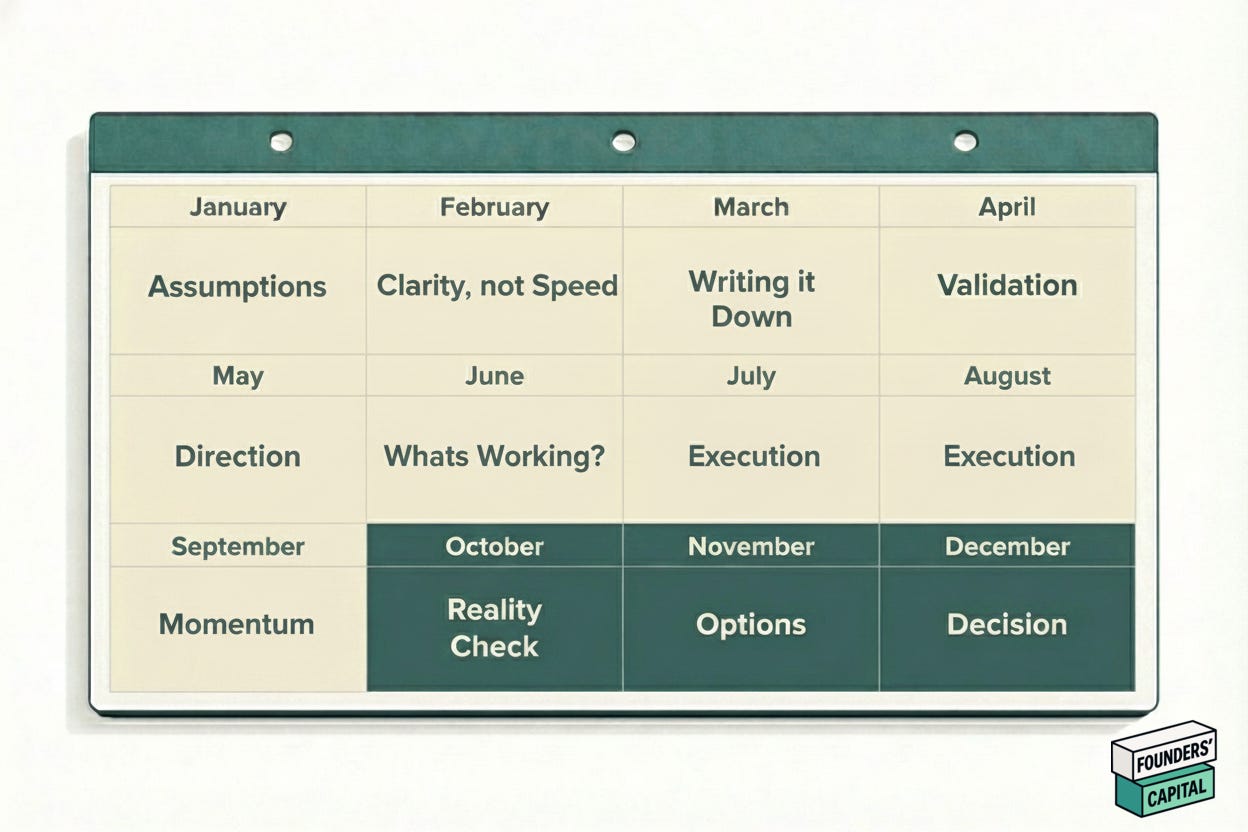
Foundation (Months 0–3) — clarity before speed
Validation (Months 3–6) — learning before scaling
Build & Focus (Months 6–9) — execution with constraints
Prepare for Scale (Months 9–12) — optionality and honesty
Each phase needs different tools. Using the wrong structure at the wrong time is what creates confusion.
Let’s start at the beginning.
Phase 1 (Months 0–3): Foundation
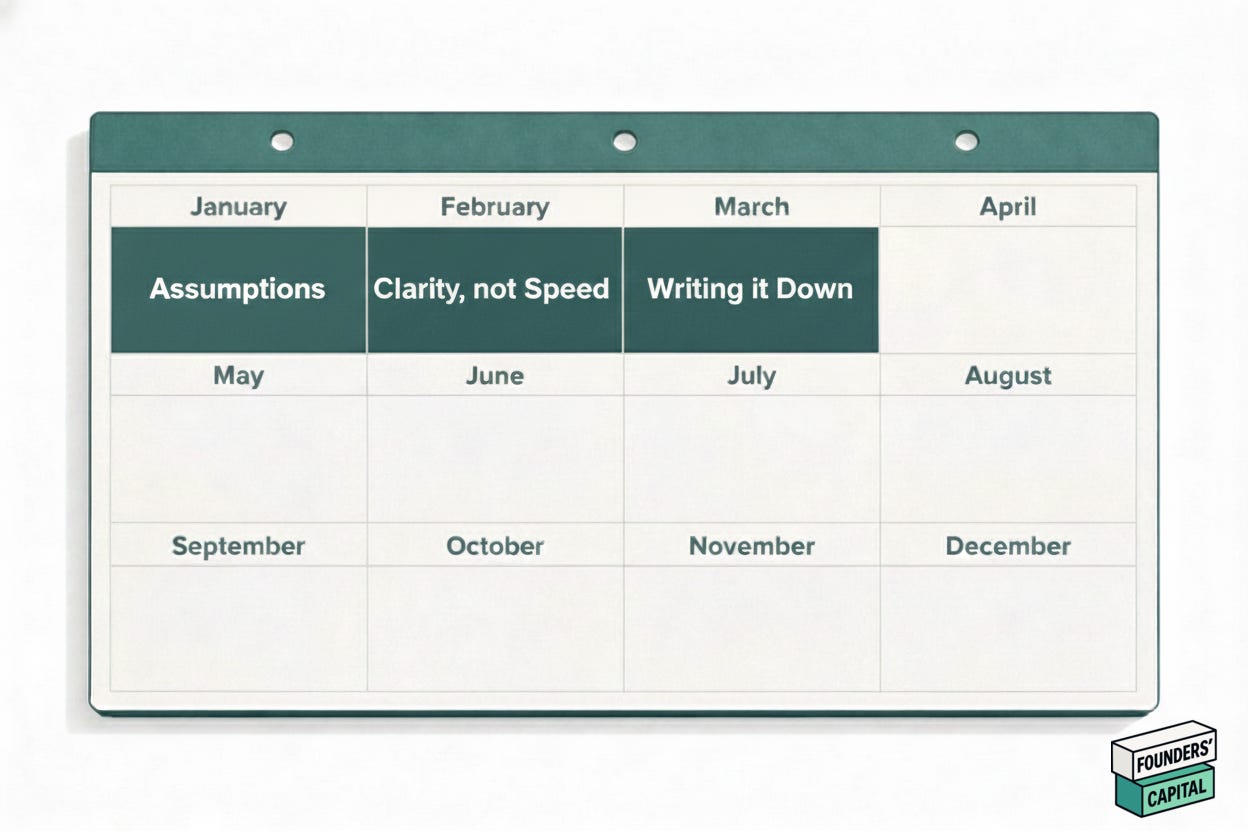
What this phase is really about
The first three months are not about growth.
They’re about locking in clarity on things that are expensive to change later.
Founders often rush this phase because it doesn’t feel productive. But skipping structure here creates confusion that shows up months later.
Your goal in this phase is not perfection.
It’s explicit assumptions.
What to focus on in this phase
Keep it simple. Focus on answering:
What problem are we actually solving?
Who is this for (specifically)?
Why are we the right people to work on this?
What does not matter right now?
You don’t need detailed answers—just written ones.
Templates to use in Phase 1
Below are lightweight templates designed to force clarity without over-planning.
1. Business Plan
Use this to document your core assumptions in one place.
What it helps with:
Clarifying the problem, customer, and value
Writing down rough milestones
Making implicit thinking visible
👉 Template: Business plan
👉 Tip: Treat this as a working document, not a pitch.
2. Business Model Canvas
This is useful for seeing the whole business on one page.
What it helps with:
Understanding how different pieces connect
Spotting obvious gaps early
Aligning co-founders quickly
👉 Template: Business Model Canvas
3. SWOT Analysis
A quick way to surface constraints and risks you might ignore.
What it helps with:
Being honest about weaknesses
Understanding external risks early
Preventing overconfidence
👉 Template: SWOT Analysis Template
How to use these templates (important)
Don’t fill everything perfectly
Don’t involve too many people yet
Don’t try to “finalize” anything
The goal of Phase 1 is shared understanding, not commitment.
If you finish this phase feeling slightly uncertain, but clearer than before - you’re doing it right.
Phase 2 (Months 3–6): Validation & Direction
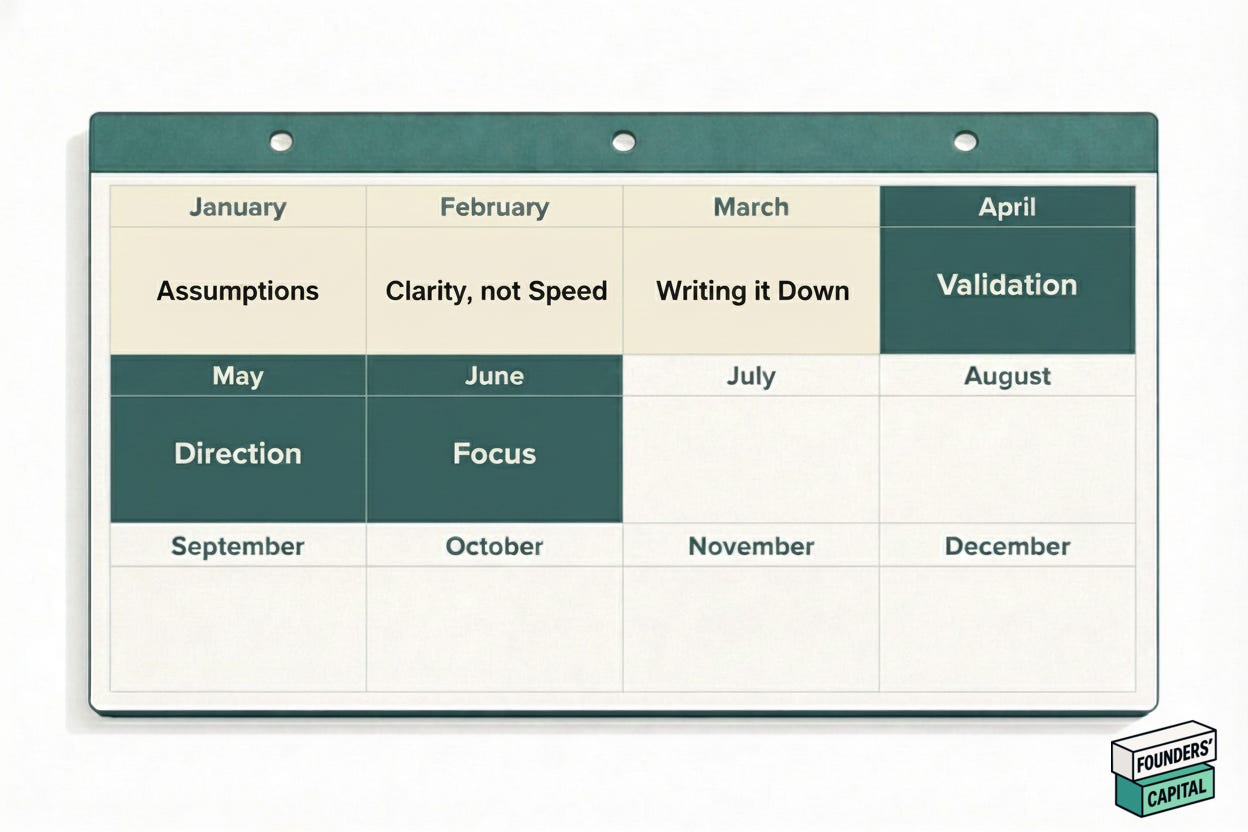
What this phase is really about
This phase is where most founders think they are building — but they’re actually still learning.
The biggest mistake here is premature execution: building too much, hiring too early, or committing before enough uncertainty is removed.
Your goal in Phase 2 is simple:
Replace guessing with evidence.
Not growth. Not scale.
Direction.
What to focus on in this phase
In months 3–6, you should be asking:
What assumptions are proving wrong?
What signals actually matter?
Where should we narrow focus instead of expanding?
This is the phase where structure protects you from false confidence.
Templates to use in Phase 2
1. Simple Startup Roadmap (Quarter-Based)
Use this to map learning goals instead of features.
What it helps with:
Breaking work into 30–60–90 day chunks
Avoiding “random progress”
Making trade-offs visible
👉 Template: Free Startup Roadmap Templates.
2. Experiment / Assumption Tracking Sheet
This is one of the most underused tools in early startups.
What it helps with:
Writing down assumptions explicitly
Tracking what you tested
Avoiding repeated mistakes
👉 Template: Experiment Tracking Template
3. Simple Milestone Planner
Use this to define progress markers that are not vanity metrics.
What it helps with:
Creating checkpoints without pressure to “scale”
Aligning co-founders on what progress means
Avoiding constant reprioritization
👉 Template: Project Milestone Plan
How to use these templates
Don’t optimize for speed
Don’t lock long-term plans
Don’t confuse movement with progress
In this phase, the right structure helps you slow down the right decisions — so you can move faster later.
If Phase 1 was about clarity, Phase 2 is about confidence earned, not assumed.
Phase 3 (Months 6–9): Build & Focus
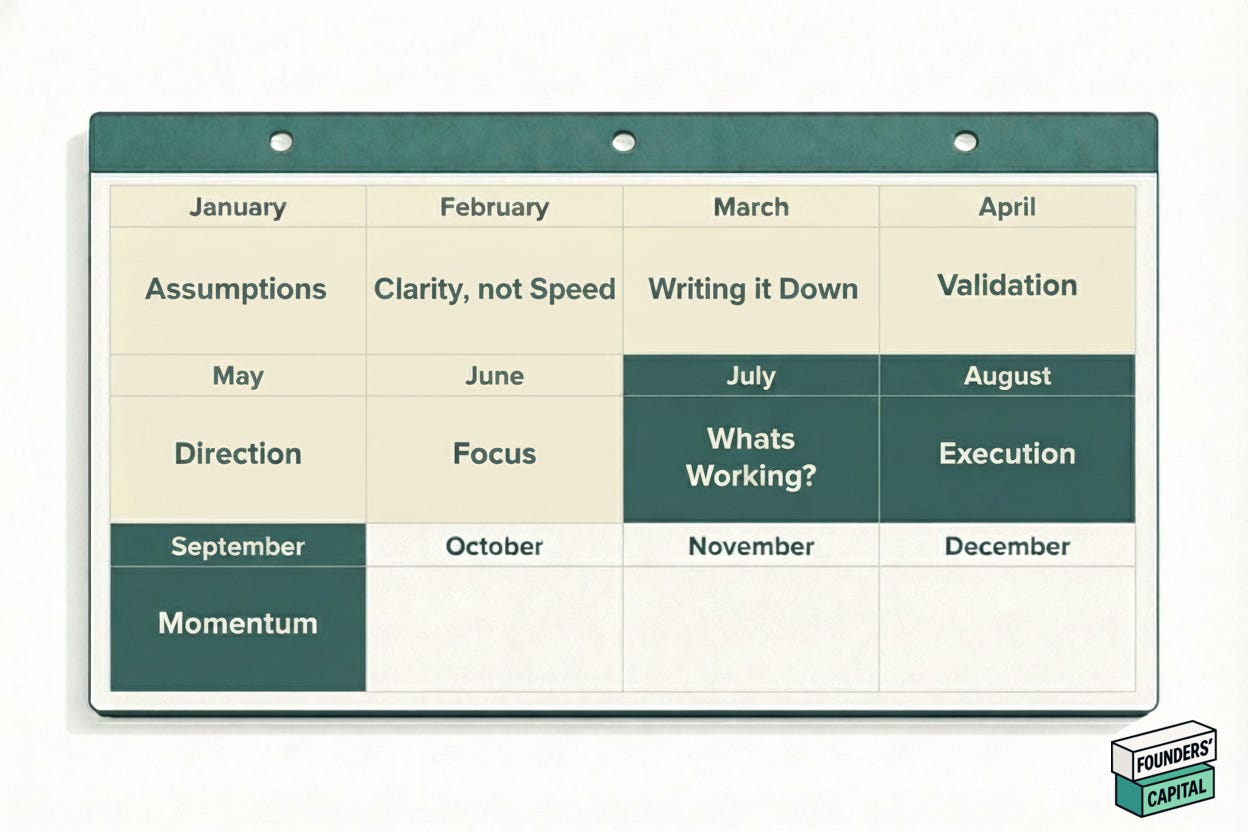
What this phase is really about
By this point, you’ve learned enough to stop exploring everything.
Phase 3 is where many startups stall — not because they lack ideas, but because they refuse to narrow focus.
This phase is about execution with constraints.
The goal is not to do more.
It’s to do fewer things deliberately.
What to focus on in this phase
During months 6–9, founders should be asking:
What are the 2–3 things that matter most right now?
What work actually moves the company forward?
What should we explicitly not be working on?
Structure here protects you from distraction and burnout.
Templates to use in Phase 3
These templates help convert learning into repeatable execution.
1. Monthly Execution Plan
Use this to define what must happen in the next 30 days — and nothing else.
What it helps with:
Preventing overcommitment
Creating realistic momentum
Aligning small teams
👉 Template: GRANTT CHART
2. Weekly Planning & Review Template
This helps founders avoid the “busy but stuck” feeling.
What it helps with:
Closing loops weekly
Reducing context switching
Building execution rhythm
👉 Template: 12 Week Planner Template
3. KPI / Progress Tracker (Lightweight)
This is not about dashboards or metrics overload.
It’s about tracking signals, not vanity numbers.
What it helps with:
Seeing progress clearly
Avoiding emotional decision-making
Staying honest about momentum
👉 Template: KPI Sheet
How to use these templates (important)
Keep plans short
Review weekly, not daily
Remove tasks aggressively
A useful rule in this phase:
If everything is important, nothing is.
Phase 3 works when structure reduces noise, not adds process.
Phase 4 (Months 9–12): Prepare for Scale (or Reset)
What this phase is really about
By month nine, most startups reach an uncomfortable moment.
Things are no longer hypothetical—but they’re not obvious either.
This is the phase where optimism alone becomes dangerous.
What you need now is honest evaluation and optionality.
The goal of Phase 4 is not to force growth.
It’s to decide what kind of future you’re actually preparing for.
What to focus on in this phase
In months 9–12, founders should be asking:
What is clearly working?
What is clearly not?
If we repeated the last 6 months, would outcomes meaningfully change?
Are we preparing to scale—or to rethink direction?
This is where structure protects you from both denial and premature ambition.
Templates to use in Phase 4
These templates help founders step back and make deliberate choices.
1. Year-in-Review / Retrospective Template
Use this to summarize what actually happened—not what you hoped would happen.
What it helps with:
Separating signal from noise
Identifying repeatable strengths
Seeing patterns across decisions
👉 Template: Retrospective Template
2. Scenario Planning Template
This helps founders stop thinking in single outcomes.
What it helps with:
Preparing for multiple paths (scale, slow growth, reset)
Reducing emotional decision-making
Avoiding all-or-nothing thinking
👉 Template: Scenario Template
3. Runway & Resource Planning Template
This is about time, not just money.
What it helps with:
Understanding how long you can operate under different choices
Seeing the cost of delay
Making trade-offs explicit
👉 Template: Startup Runway Calculator
How to use these templates (important)
Don’t rush this phase
Don’t sugarcoat results
Don’t anchor on sunk costs
Phase 4 works when founders are honest without being harsh.
The output of this phase should be one clear answer:
What are we intentionally preparing for next?
How to actually use this guide (without overthinking it)
This guide is not meant to be filled out all at once.
The mistake most founders make is trying to “get organised” in a single weekend. That usually leads to half-filled templates and no real change in how decisions are made.
Use this guide one phase at a time:
If you’re early, only use Phase 1
If you’re mid-way, skip ahead without guilt
If you’re unsure where you are, Phase 4 will make that obvious
The goal is not to predict the future.
It’s to make better decisions with the information you have today.
A simple rule that helps:
If a template doesn’t change a decision, you don’t need it yet.
A quick recap of the structure
To summarise, here’s how the first 12 months break down:
Months 0–3: Foundation
Create clarity. Make assumptions explicit. Avoid rushing.Months 3–6: Validation & Direction
Reduce uncertainty. Learn deliberately. Narrow focus.Months 6–9: Build & Focus
Execute with constraints. Say no more often. Build momentum.Months 9–12: Prepare for Scale (or Reset)
Be honest. Plan for multiple futures. Protect optionality.
Each phase requires different structures.
Using the wrong structure at the wrong time is what creates confusion.
Why structure matters more than motivation
Most founders don’t lack motivation.
They lack containers for decision-making.
Structure does three important things:
It reduces noise
It makes trade-offs visible
It prevents small mistakes from compounding quietly
You don’t need a perfect plan.
You need a clear enough structure to move forward intentionally.
That’s what this guide is meant to provide.
Final thought
The first year of a startup will always feel messy. That’s normal.
But chaos doesn’t have to mean confusion.
With a few simple structures — and the right templates at the right time — you can turn your first 12 months from a blur into a sequence of deliberate decisions.
That alone puts you ahead of most founders.
Best,
Ashish
Really cool overview and great reminders ☺️
This phased framework is exceptionally practical - especially the emphasis on “clarity before speed” and honest evaluation in months 9–12. That same disciplined, stage-gated thinking applies to building financial operations: starting with basic cash flow tracking, validating payment terms, systematizing credit checks, and finally preparing liquidity buffers for scale. TCLM often explores that progression for early-stage finance leaders. A valuable read.
(It’s free)- https://tradecredit.substack.com/