

SAFE vs Priced Round: What Founders Actually Give Up
It feels free. It is a valuation you agreed to before you knew the price.

A SAFE feels free. There is no valuation to fight over, no board to seat, no lawyers billing for weeks. You sign a few pages, the money lands, and you get back to building.
That feeling is exactly the problem. A SAFE is not free money. It is a delayed dilution you agreed to before you knew the price. The bill arrives later, at the priced round, and it is often bigger than the founder pictured.
This is not an argument against SAFEs. They are a genuinely useful instrument, especially early. It is an argument for understanding what you are signing, because the whole appeal of a SAFE, that you skip the valuation conversation, is also the trap.
A SAFE is a valuation you agreed to early
A priced round sets a valuation today. Everyone knows exactly what they bought and what you sold. A SAFE postpones that moment. The money comes in now, and the ownership is settled later, when the SAFE converts into shares at your next priced round.
So a SAFE does not remove the valuation. It hides it inside two numbers: the cap and the discount. Those two numbers decide how much of your company that early cheque actually buys, and founders routinely underestimate both.
The cap is the number that really matters
The valuation cap is the maximum valuation at which your SAFE converts. It is the single most important term in the document.
Here is how it bites. Say an angel puts in money on a SAFE with a 5 Million cap. A year later you raise a priced round at a 10 Million pre money valuation. The new investors buy in at 10. The SAFE holder, because of the cap, converts as if the company were worth 5. Their money buys shares at half the price the new money pays, so they get roughly double the ownership their cheque would have bought at the round price.
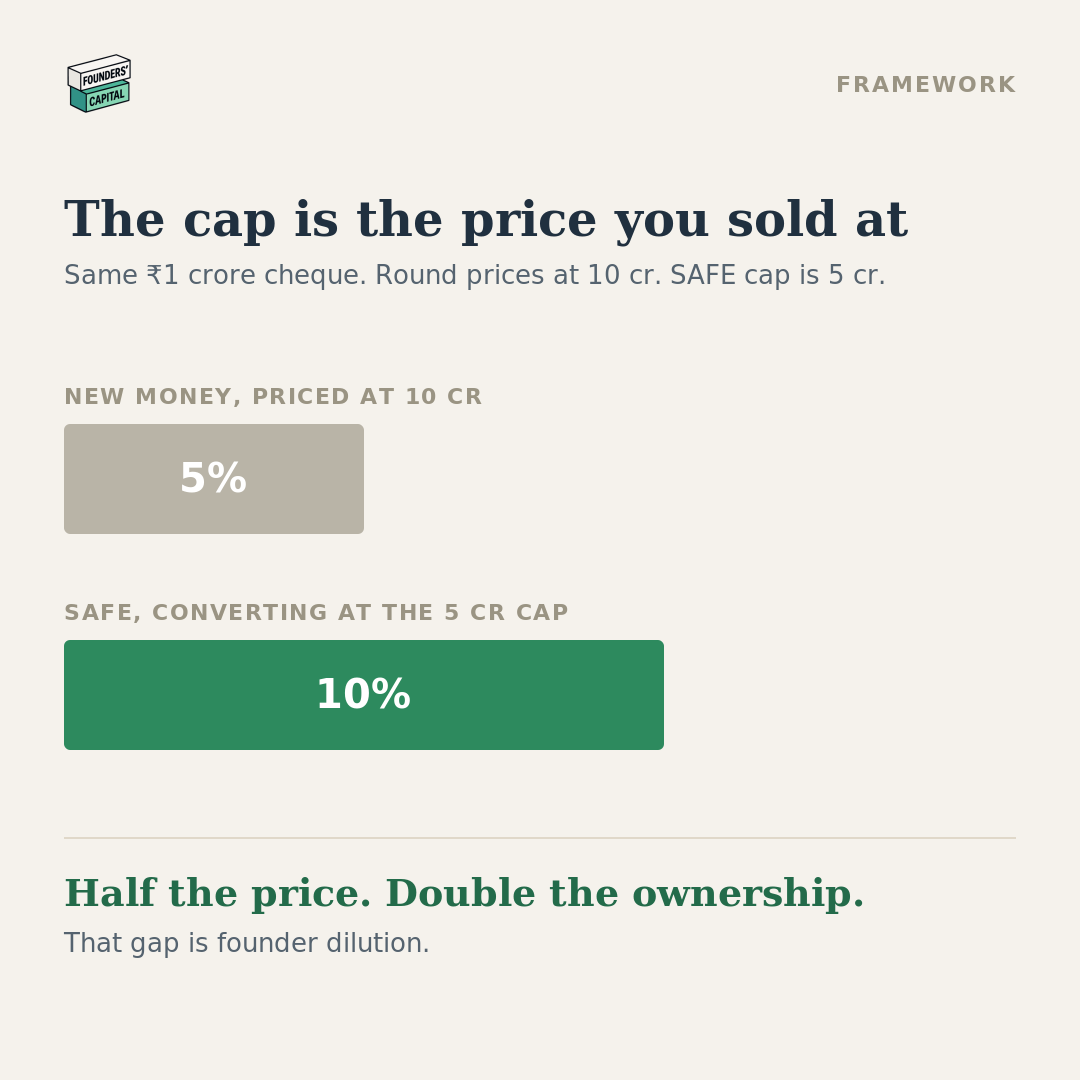
That is not a mistake or a trick. It is the reward the early investor negotiated for taking the early risk. But it means the cap you agree to is, in practice, the price you are selling at, and if your company does well, the gap between the cap and the round price comes straight out of founder ownership.
The discount stacks on top
Many SAFEs also carry a discount, often 10% to 20%. That lets the SAFE convert a set percentage cheaper than the new money, on top of any cap benefit.
On its own a discount is mild. Combined with a low cap, it compounds. The investor gets the better of the two, or in some structures effectively both, and your dilution grows a little more than you expected.
Now stack them.
One SAFE is easy to reason about. Real cap tables rarely have one. They have a friends and family SAFE at one cap, an angel SAFE at another, an accelerator SAFE at a third, each converting at its own price, plus the standard option pool the priced round will ask you to top up.
Add those together and the founder dilution at the priced round is the sum of every early promise you made, and you meet the total for the first time on the day the round closes. This is why so many founders who “just did a quick SAFE round” are surprised by their own ownership number later. Nothing went wrong. The math was simply never laid out end to end.
SAFE vs priced round, honestly
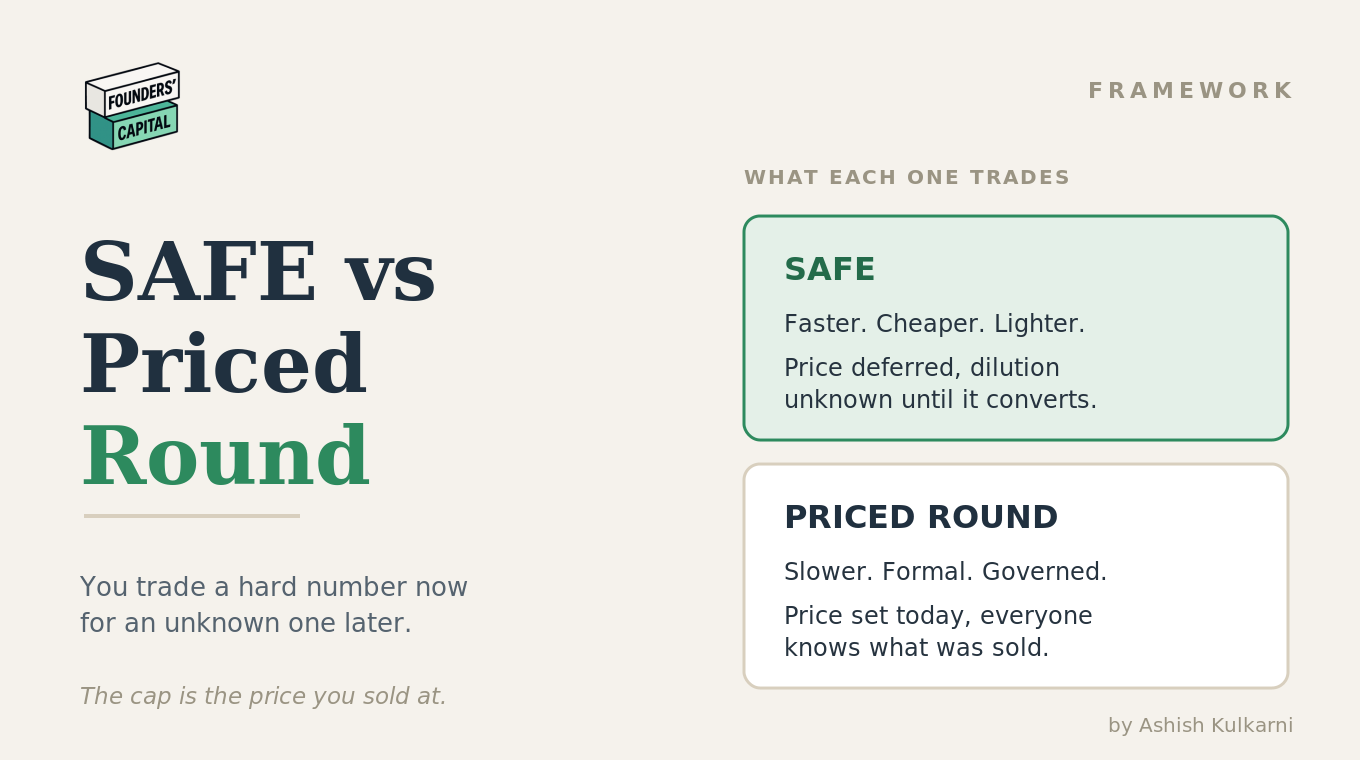
Neither instrument is better in the abstract. They trade different things.
A SAFE is faster, cheaper, and lighter. It defers the valuation fight, keeps you in control while you are small, and gets money in quickly. The cost is uncertainty: you are agreeing to a price mechanism, not a price, and the final dilution is only clear later.
A priced round is slower, more expensive, and more formal. It sets a real valuation, brings governance, and usually a lead investor. The benefit is clarity: everyone knows exactly what was bought and sold on the day it happens.
The honest rule of thumb: SAFEs suit the earliest, smallest cheques where speed matters and amounts are modest. The more you raise, and the more SAFEs you stack, the more you owe it to yourself to price the round or at least model the conversion as if it were priced.
The resource: what to model before you sign a SAFE
Before you sign any SAFE, run these five checks. Each one takes minutes and saves points of your company.
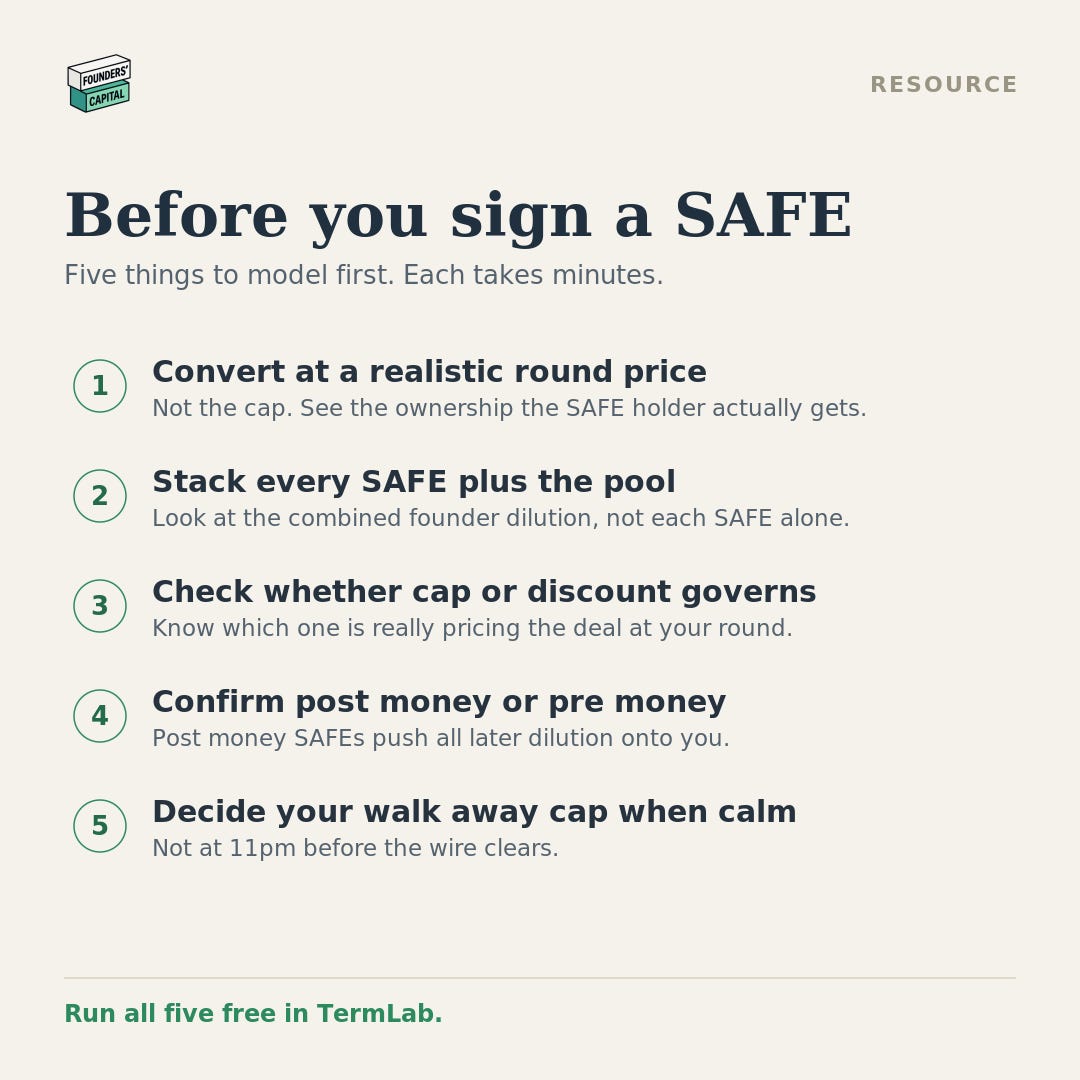
1. Convert it at a realistic next round price, not the cap. See the ownership the SAFE holder actually gets.
2. Stack every existing SAFE together and add the option pool top up. Look at the combined founder dilution, not each SAFE alone.
3. Check whether the cap or the discount governs at your expected round price, so you know which one is really pricing the deal.
4. Confirm whether it is post money or pre money. Post money SAFEs fix the investor’s percentage and push all later dilution onto you.
5. Decide your walk away cap before the conversation, when you are calm, not at 11pm before the wire.
You can run all five for free, no account needed, in TermLab. It converts SAFEs at any round price, stacks multiple SAFEs, and shows the founder dilution before you sign anything.
The Takeaway
A SAFE trades a hard conversation now for an unknown number later. That is a fair trade only if you make the number known before you sign. Model the conversion, stack the SAFEs, and price the round in your head even when the paper lets you skip it.
The cheapest money you will ever raise is the term you actually understood.
Best,
Ashish