

The Data Room "Competence Test": What Your Metrics Actually Signal
Investors don't just read your data room to see if the business works—they read it to see if you work.


A well-organized data room can cut your fundraising timeline by 30 days. A messy one can collapse your deal before due diligence even begins. But most founders treat this as a logistics problem.
They’re missing the real game.
Your data room isn’t primarily about organization. It’s a signal about how you’ll steward capital, how much control you’re willing to share, and what kind of investor you’re trying to attract. The documents matter far less than what they say about your decision-making.
Why This Matters for Your Capital Negotiations
89% of investors now require secure digital access to due diligence materials via a virtual data room, according to Visible.vc research. The VDR market is growing at 16% annually, projected to hit $1.6 billion by 2026. But here’s the uncomfortable truth: 35% of startup deals experience delays due to mismanaged data rooms, and nearly half collapse entirely during due diligence.
Those aren’t organizational failures. They’re capital discipline failures.
When a VC opens your data room and finds inconsistent numbers, poor filing structure, or missing documentation, they’re not just thinking “this founder is disorganized.” They’re thinking: “How will this founder manage my capital? Will my investment actually be tracked correctly? Do they even know their own unit economics?”
A well-prepared data room answers a deeper question: Are you someone I want to give control to?
The Timing Debate Reveals the Real Power Dynamics
Here’s where the fundraising world splits into two camps—and they’re arguing about something entirely different than they realize.
Camp A (The Preparation Camp): Andreessen Horowitz, Y Combinator, and most institutional VCs tell you to prepare your data room before you start fundraising. Justine Moore from a16z is explicit: “If possible, try to have your data room prepared before officially kicking off your fundraise.”
Their logic: preparation signals professionalism, momentum, and competence.
Camp B (The Anti-Data Room Camp): Mark Suster of Upfront Ventures says data rooms “are where fundraising processes go to die.” He’s not wrong about why—premature data room sharing gives investors an easy exit. Bryce Roberts is even more blunt: “No one finds conviction in the data room.”
Their logic: conviction comes from your vision and traction, not spreadsheets. Share the room too early and investors use it as a delay tactic.
What’s actually happening? These camps are describing the same phenomenon: data rooms are a leverage tool. When you hand over access early, you’re giving investors time to nitpick. When you withhold access, you’re forcing them to either engage with you or move on.
The real consensus comes from Jason Yeh of Adamant Ventures: “You shouldn’t share data rooms unless you believe an investor is actually leaning in.” He treats data room access like a carrot—evidence that an investor is serious enough to deserve the details.
The capital implication: Your data room strategy isn’t about when you’re “ready.” It’s about maintaining negotiating power. Share too early and you’re asking investors to validate you. Share at the right moment and you’re saying you’ve already decided they’re worth your time.
Stage-Specific: Where Your Leverage Actually Is
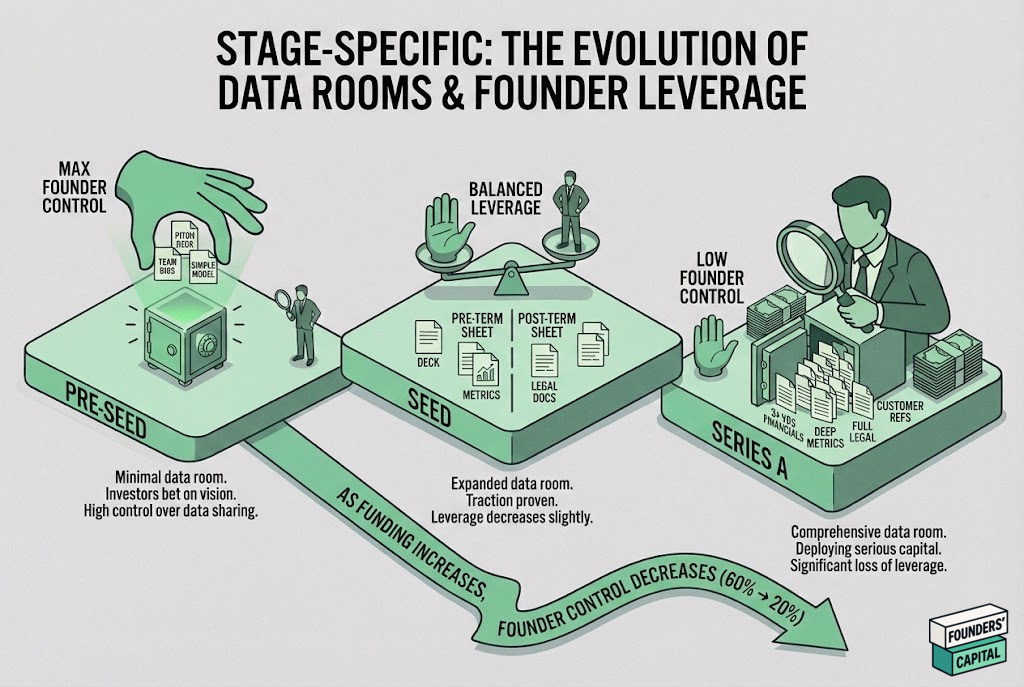
Data room expectations evolve dramatically as companies mature—and so does your relative power in negotiations.
Pre-seed stage: Investors bet on team and vision, not traction. Your data room should be minimal because that’s all you need. Must-haves include a 10-15 slide pitch deck, executive summary, team bios, simple cap table, and 12-18 month financial model. This is the stage where you have maximum control. You’re not yet dependent on capital. Investors know this. You can afford to be selective about data sharing.
Seed stage: Now you have traction data. The data room expands into two phases—pre-term sheet (pitch deck, demo video, early metrics, cap table, historical P&L) and post-term sheet (board minutes, legal docs, full contracts). Notably, investors can now request deeper documentation because you’ve proven the product works. Your leverage decreases slightly.
Series A: This is where you lose significant leverage. According to Underscore VC’s framework (which is the most practical resource for this), you need comprehensive materials: 3+ years of monthly historical financials, key metrics dashboard, detailed cap tables, customer references, recent investor updates for the past 6 months, and complete legal documentation. Investors expect depth because they’re deploying serious capital. You can’t say “that’s confidential” anymore.
The pattern is clear: as you raise more money, you have less ability to protect your information and control the narrative.
Per Underscore VC’s Series A Data Room resource, the checklist has expanded significantly. Early stage, you might control 60% of what’s shared. Series A, it’s closer to 20%.
Which Metrics Actually Control Your Destiny
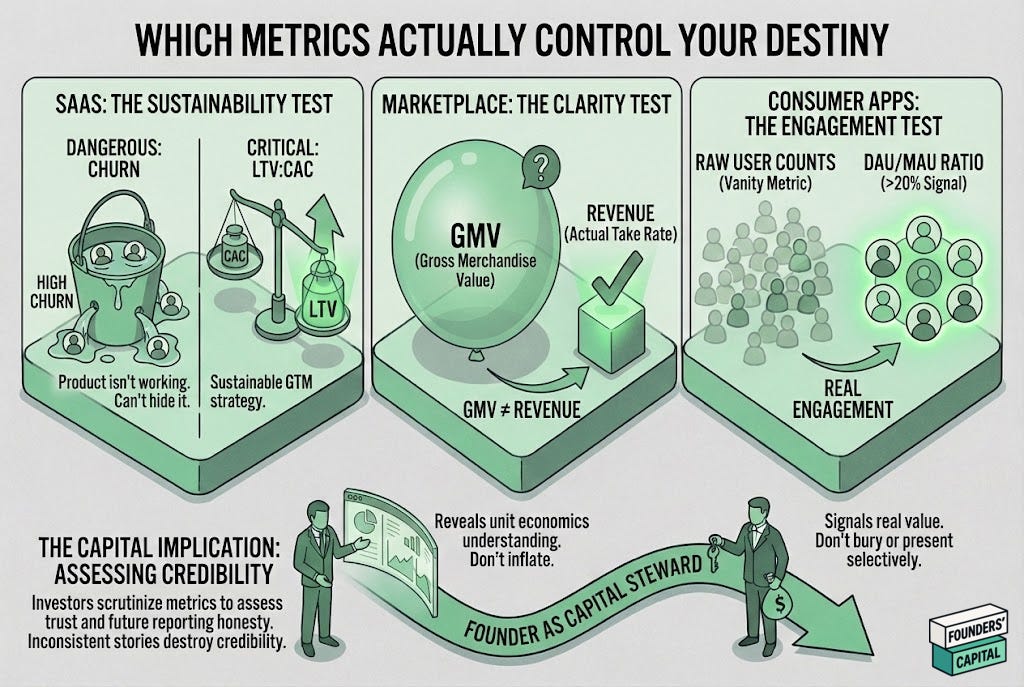
Not all metrics matter equally. Some reveal founder competence, others reveal founder progress, and some reveal founder vulnerability.
For SaaS startups (the most scrutinized model), VCs will examine MRR/ARR trends, churn rates, net revenue retention, LTV:CAC ratios, and burn multiples. The dangerous metrics? Churn and CAC payback period. These tell investors whether your product is actually working and whether your go-to-market strategy is sustainable. A founder with bad churn can’t hide it in a data room.
For marketplace startups, the critical distinction is GMV vs. actual revenue. A16z explicitly warns: “GMV is not revenue.” This matters because it reveals whether founders understand unit economics. If your data room shows inflated GMV without corresponding take rate clarity, investors assume you’re either unsophisticated or hiding something.
For consumer apps, the real metric is DAU/MAU ratio. It’s not about raw user counts. Andrew Chen’s research shows that a 20%+ DAU/MAU ratio signals real engagement. A founder who buries this metric or presents only favorable cohorts signals dishonesty.
Here’s the capital implication: Investors don’t scrutinize metrics to understand your business. They scrutinize them to assess your credibility as a capital steward. If you’re selective about which cohorts you show or your metrics don’t reconcile with your story, investors assume you’ll be selective about how you report to them post-investment.
The Red Flags That Actually Kill Deals
Most founders think data room failures are about disorganization. They’re not. They’re about signals.
Inconsistent numbers across documents ranks as the top red flag according to Andreessen Horowitz. Your pitch deck says $2M ARR, but your model shows $1.5M. What investors read: “This founder doesn’t actually know their own business or isn’t being truthful.” Neither option is acceptable to someone deploying capital.
Poor organization signals poor stewardship. Richard Dulude of Underscore VC is direct: “I assume you run your company like you run your deal room.” Dumping files into a folder without structure tells an investor that either (a) you don’t care about systems, or (b) you’re not sophisticated enough to build them. Either way, why would they trust you with their capital?
Cherry-picked metrics backfire immediately. Justine Moore: “Don’t cherry-pick your best cohorts. Include the full data.” When investors discover you’ve hidden bad cohorts (and they will), the conversation shifts from “Should we invest?” to “What else are you hiding?” Your credibility collapses.
Over-documentation creates confusion. Founders often include documents VCs explicitly don’t want: detailed 3-5 year projections, tax returns, org charts, board minutes. This signals either (a) you don’t understand what investors care about, or (b) you’re burying important information under noise. Both are red flags.
Starting too late creates desperation. A founder who uploads documents the day before investor meetings is signaling that they don’t take their own business seriously. If you’re not organized enough to prepare before pitching, why should anyone believe you’ll be organized with their capital?
The Two-Stage Strategy: How to Maintain Agency
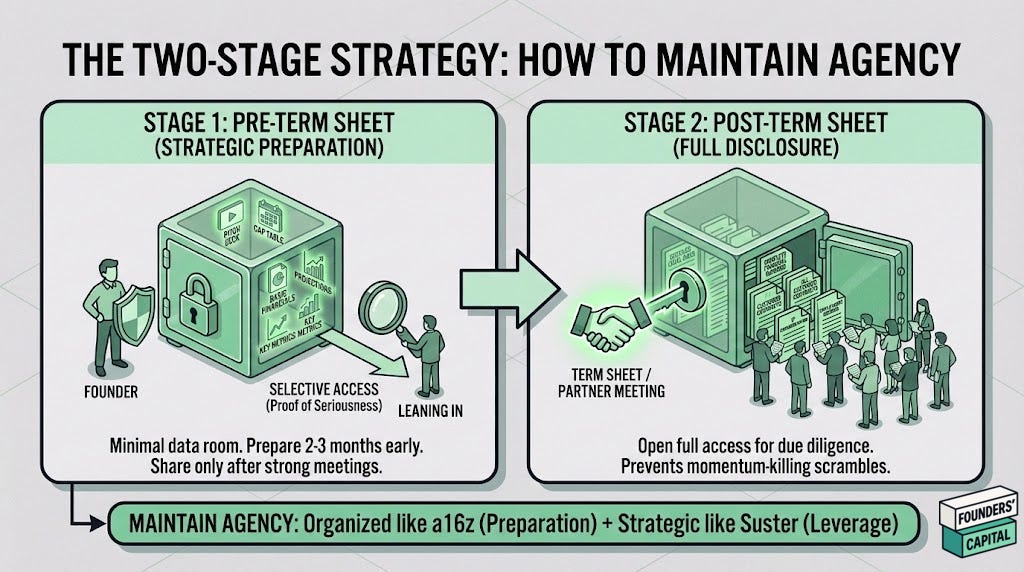
The practical resolution to the timing debate follows a two-stage approach:
Stage 1 (Before term sheet): Prepare a minimal data room 2-3 months before you start fundraising. Include pitch deck, cap table, basic financial history, 12-18 month projections, and key metrics. Don’t share this widely. After strong initial meetings with investors, provide Stage 1 materials only to those you believe are “leaning in.” This is where Jason Yeh’s logic applies—use data room access as proof of investor seriousness.
Stage 2 (After serious engagement): Open full access only when an investor reaches term sheet stage or sends a serious final partner meeting invitation. Now include detailed legal documents, complete financial records, all customer contracts, IP documentation, and employment records.
This approach gives you the best of both camps. You’re organized like a16z recommends (preparation signals discipline), but you’re strategic like Suster recommends (selective sharing maintains leverage).
Y Combinator’s Series A Diligence Checklist provides the definitive list of what to expect post-term sheet. Having these items ready prevents last-minute scrambling that kills momentum.
The Deeper Game: Data Rooms as Capital Discipline
Here’s what’s really happening when you build a data room: You’re proving to investors that you can manage capital responsibly.
Academic research from Wharton (Fu & Taylor, 2025) found that investors spending 20+ hours on due diligence achieved 5.9x returns versus 1.1x returns for those spending fewer than 20 hours. That suggests VCs who scrutinize thoroughly make better investments.
When VCs ask for comprehensive data room access, they’re not being difficult. They’re doing the work required to make a smart capital allocation decision. A founder who resists this process signals weakness. A founder who welcomes it and makes it easy signals strength.
The irony: The founders who nail their data rooms aren’t necessarily the best operators. They’re the founders who understand that the data room is where capital discipline begins.
Where to Start: Practical Resources
You don’t need to build this from scratch:
Underscore VC’s Google Drive folder structure — Copy this directly. It’s built by VCs who do this professionally. Their best practices guide explains exactly what they want to see.
Pulley’s cap table template — Free, structured, works for early-stage companies.
Notion’s official data room template — Pre-built structure with categories for financials, legal, and team info.
Sequoia Capital’s 10-slide pitch deck framework — The gold standard structure, used by Airbnb and YouTube.
The action is straightforward: copy the Underscore VC structure, use free templates for financials and cap table, ensure every number across documents matches exactly, and keep it updated throughout fundraising.
The Real Conclusion
A data room that impresses investors most is the one that demonstrates the same rigor and attention to detail they hope to see in your operations. It’s not about having the fanciest presentation or the most documents.
It’s about discipline.
When you build a disciplined data room, you’re sending a signal: “I understand capital. I respect it. I’ll manage it responsibly.” That signal matters more than any pitch.
The 30-day timeline reduction from well-organized materials isn’t because organization is magically efficient. It’s because a clean data room signals founder competence, which reduces investor risk assessment time.
Start now. Don’t wait until you’re officially fundraising. A founder who’s organized from day one isn’t organizing for the data room—they’re organizing for operational excellence. And that’s exactly the kind of founder capital wants to back.
Best,
Ashish